Posts

Showing posts with the label workhouse blog

Books for the New Year

Image
I know that no one wants to talk about New Year Resolutions but I am very happy with my vow to use the local library more. It is a win/win situation. The library gets user support, which is increasingly important in the wake of so many library closures. As the saying goes, if you don't use it, you lose it! After all, what's not to love about lots and lots of free books, and getting a healthy time-out from digital devices. Libraries are especially important if, like me, you don't have the money to splash out on rare or special interest books. With this in mind let's have a look at some of the great workhouse books that are out there, all of which I have borrowed from my local library in Portumna. Grim Bastilles of Despair by Paschal Mahoney is one of the latest books to be written specifically about Irish workhouses. Do not be put off by the title. This volume is a series of essays which makes it really easy to read. Paschal is an architect, so this volume ...

It's Shorelines Time Again!

Image
Shorelines has taken over Portumna. The festival has once again filled the town with lots of thought-provoking, quirky, and just plain enjoyable arty-type stuff. The Irish Workhouse Centre has not been spared and we are delighted to be jam packed with delicious art in all shapes and forms. Once again we are all reminded what a great gallery space the workhouse is, and for those of you who wonder how cultural events fit in with the history of this site, here is some food for thought. The workhouse was originally meant to provide help and support to their immediate localities. They failed massively in this duty of care, but we can now readdress this balance using the same site. Heritage spots like ourselves, can and should be embedded in their local communities, providing something for everyone. Let's not keep making the mistakes of the past. Arts are the succour of the soul. The most heart-rending fact I learnt from tour guiding at the workhouse is that paupers, tho...

Irish Workhouses and Genealogy (Part 2)

-Parliamentary & Civil Records- Not all records relating to Irish Workhouses were generated in-house. In fact, much of what survives today are records created by the government.  A great government record is the 1901 and 1911 Census. This census lists all the inhabitants and staff of the various workhouses. Please note that the paupers are usually listed by initials. We can also use newspapers as a surprisingly full source of information about workhouse inmates and staff alike. If you are lucky you may even find information given about a pauper's family or the conditions leading to their admittance to the workhouse. The Freeman’s Journal, 27 August 1864 for example, refers to a man named Howard, commiserating with his fate and his diet, ‘…the horrid stuff miscalled “bread”, on which he was fed was unlike anything with which the paupers were fed before’. [1] In the case of Portumna Workhouse the most useful set of records are those of the civil death registers...

Workhouse Personalities-Kitty and Mary Madden

Image
Nenagh Guardian , Examination of Kitty Madden, 27 July 1864 In light of the recent Madden Gathering at the Workhouse, we have been looking at the Maddens admitted here over the years. The most riveting case we have found revolves around Mary Madden and her mother, Kitty.  Mary Madden was born about 1834. She was paralyzed, blind and suffered from seizures.   It was reported that Kitty Madden carried on caring for her daughter until the elderly lady could no longer even take care of  herself. After admission to the workhouse, there are reports of a nother inmate in the workhouse, Judy Solon, taking care of Mary Madden on occasions. However, the story of Kitty Madden and her daughter does not end here. Kitty is mentioned in newspaper articles after appearing as a witness in a workhouse inquiry. The inquiry looked into the mistreatment of paupers and their allegations of substandard food. It was stated that t he Indian meal used in the workhouse to make br...

All the Falling Stones

Image
I am always amazed by the sheer volume of talented artists and crafts people I get to meet as part of stocking the Workhouse Gift Shop. Just when I think I've seen everything, a new product or approach comes along and I have to resist buying one of everything! All the Falling Stones is a series of atmospheric prints by photographer Claire Loader. The prints are fixed onto wooden blocks so that the prints can be free-standing as well as wall mounted. Claire is originally from the 'other' Westport, a coastal town on the South Island of New Zealand. After meeting her husband in China, she took the plunge and moved to Ireland. That was 9 years ago and the New Zealand photographer has been enchanted with Ireland ever since. Like many visitors to Ireland, Claire has never gotten over the amount of castles and abbeys, pure history, often just sitting out in a field somewhere. Immune to steady drizzles, muddy boots and even the odd unfriendly bull, Claire has set about exp...

Heritage Week Plans for 2018

Image
August is always an exciting month for the Irish Workhouse Centre as we celebrate National Heritage Week . Running from August 18th to 26th, Heritage Week will again be a major focus here. Steve Dolan (Our current Workhouse Master) with Claire Doyle (His beautiful assistant) The aim of National Heritage Week is to preserve our folklore, ancient legends and archive the stories of our past in our minds. It is an event tailored to people of all ages and represents every facet of the Irish identity. This year, the theme of Heritage Week is ‘connections’. We encourage people to get involved and ‘make a connection’ to their heritage. Our heritage belongs to us, and it is important that we preserve and cherish it. We will host ten events over the nine days, will hold ten events off-site, and are providing nine free publications over the nine days.   No centre or museum in the county holds as many events as the Workhouse. Perhaps, some of these events might interest you......

Mysterious Paw Prints

Image
Paw-prints in the brick floor of the Laundry House It all started with a chance sighting of animal footprints in the Laundry House. The print was not the result of dirty paws but rather a set of indentations in a brick. A colleague was quick to point out that the marks reminded him of Roman bricks and tiles. I was unfamiliar with the phenomenon but was delighted to find a whole host of examples on-line. My favourite is an example from Northumberland which dates from the 1st century. This Roman tile has three pig-trotter prints and two faint dog paw-prints. So how did the prints end up in our bricks? The secret lays in the process of brick making.  1st Century Roman Tile-Northumberland Bricks and tiles have a long history of being dried in the sun before they are baked in the ferocious heat of a kiln. This basking in the sun lets a lot of the moisture escape. This may seem like extra work when the clay could just be packed into the kiln and fired, but it is wort...

Personalities of the Workhouse-Bridget Corbett

Image
                                                      The exact window from whence Bridget ended her life The story of Bridget Corbett is one of the saddest to come out of Portumna workhouse. Her experiences call into question just how 'free' a person really was to leave the workhouse if they had any sort of physical impediment. In our current era of trying to increase accessibility, this story is especially sobering. We are lucky to have the details of the case from a newspaper report dated November 1872 which tells us about Bridget's plight.  The elderly widow lay  confined to a bed for  12 months, in extreme discomfort from the effects of rheumatism. On November 10 th of that year Bridget made the first attempt on her own life but was stopped. Not to be deterred,   Mrs Corbett must have had her mind made up a...

600-a site specific art installation by Jenny Wood-Sullivan

Image
600 is a site-specific installation by artist Jenny Wood-Sullivan . The title references the quantity of paupers which could be housed in Portumna workhouse. The use of a number as the installation title immediately highlights Jenny's interest in how paupers were processed in the workhouse system, essentially reducing people to just numbers on a page. With this in mind, it is striking how visually pleasing and gentle the installation appears, with the contemplative art of origami (a Japanese technique of folding paper into a variety of forms) taking centre stage. As the visitor walks through one of the original workhouse rooms, they are witness to a flock of 600 origami birds flying down towards the floor, in a desperate attempt to reach a solitary seed. The viewer does not need to be told that there is not enough food for all. The birds themselves are folded from the pages of an old tome titled The Church and Science by Sir Bertram C. A. Windle , printed in 1917. Wha...

Dark Shadows Exhibition

Image
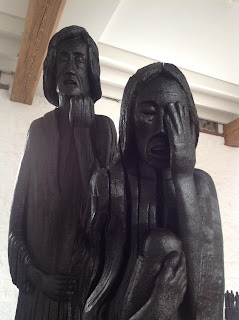
The work of Kieran Tuohy has to be seen to be believed. Perhaps it is the fact that his large sculptures are carved from single pieces of bog-wood,   or that the natural cracks in the petrified timber are as vital to the pieces as Kieran's own hand, or that the striking gleam of bog-wood is just so hard to photograph. Whatever the reason, everyone who visits the Dark Shadows Exhibition comes away ineffably changed. The impact of Dark Shadows is even more incredible given the fact that the Famine, or as many people now call it The Great Hunger , is not new to us. It is one of the nation's most defining events, a cataclysm drummed into us at school and reinforced by having Irish communities around the world. It is not for love of travel alone that the Irish Diaspora is proportionately one of the largest in the world. So to mount an exhibition which solely focuses on The Great Hunger would seem a risky venture. That is, until you are confronted with the sculptures thems...

No Place for Idle Hands-Part 2

Image
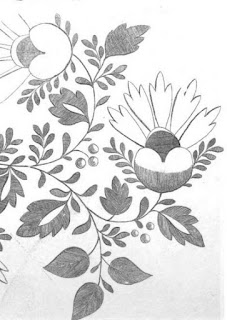
The difference between the work of women and men in Irish workhouses ·          Embroidery ·          Knitting ·          Making socks, shawls, handkerchiefs & other items of clothing ·          Lace-making ·          Crochet ·          Quilting ·          Netting ·          Flowering   & Sprigging The above list shows the variety of skilled needle-work performed by female paupers.  Note the inclusion of a type of needlework which is largely forgotten today; flowering and sprigging. This entails the embroidering of muslin with small sprays of foliage or floral patterns. Many different patterns could be used and were widely circulate...