Posts

Showing posts with the label Irish Workhouse Museum

Transition Year Art Collaboration
Image
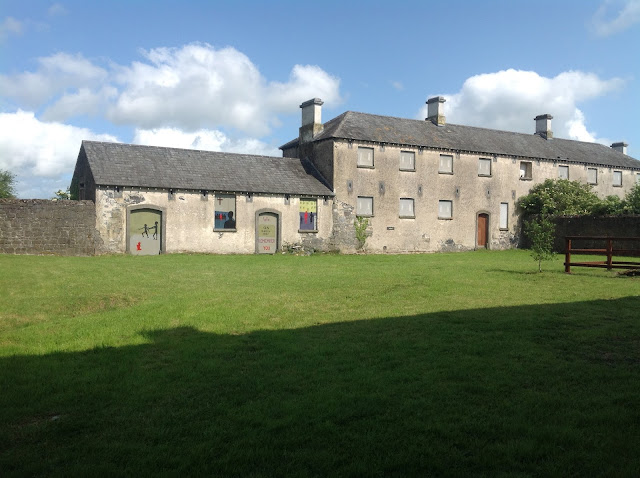
A group  of Transition Year students, namely  Jessica Madden, Keeva Duffy, Maria Quinn, Cerys Porter, Shauna Fahy and Sean Power, have reached out to Portumna workhouse. As a group they  designed and painted a series of boards for the workhouse infirmary. Here are their own words about the project. "We got inspiration mainly from what life would be like if you lived in a workhouse.  The boards consist of four scenes which are now in the places where the original infirmary doors and windows were missing.  A family entering the workhouse The paintings tell the story of a person's life in the workhouse, from our own perspective. We decided to have a main focus throughout the works; a man in red. He became our main character in the story.  The first board shows him entering the workhouse with his family. We tried to depict the fact  that the family had no other option if they wanted a chance of survival.  Seperation scen...

Workhouse Farms in Ireland

Image
Mangel Wurzel-a popular vegetable grown in Irish workhouses   For a long time, the 'work' in Irish workhouses was thought to exclude farming. However, recent research shows that many Irish workhouses had farms. Due to irregular or no account keeping, it is hard for us to piece together a picture of what farming was like in a workhouse setting. However, what we can do is look at a snap shot of figures from parliamentary documents.* These documents reveal a surprising fact. Out of the 163 workhouses across Ireland, only 37 had no land under cultivation. Over half of these 37 are from the second wave of building. Workhouse building in Ireland took place in two waves. There were the first 130 which were planned as a complete set to provide relief for 1% of the Irish population. Then the crisis resulting from potato blight led to 33 extra workhouses being hastily built. These were needed due to chronic overcrowding and it seems that acquiring farmland was the least ...

The Workhouse in Fiction

Image
Image from the 1968 movie Oliver! ‘Please sir, can I have some more?’ Most of us know this iconic line from the 1968 film version of Oliver! The quote has embedded itself in pop culture, cropping up in memes, advertisements, comedy sketches and cartoons. However, how many of us know that the line is a criticism of the meagre food quantities supplied to workhouse children? In fact, Charles Dickens wrote Oliver Twist as a rallying cry against child poverty and the failure of the workhouse system. He based this view on his first hand observations as a newspaper reporter. What he saw went into his books and shocked  his audiences. He was accused of gross exaggeration and even outright fabrication. His rebuttal was the tell people to go see for themselves, which they did. What they witnessed was all the proof he needed. Before we leave Dickens, it is interesting to note a slight connection with Irish workhouses. Oliver Twist was first published as a serial 1837–39. This peri...

Wretched Old Shoes

Image
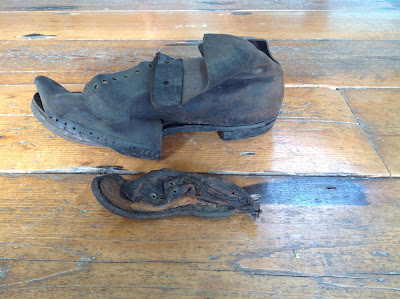
Two original items from Portumna workhouse, one is a child's shoe & the other a man's boo t. At the Irish Workhouse Museum we are delighted to have several specimens of pauper shoes. However shoes were viewed as a troublesome topic by workhouse management. Some workhouses ordered boot parts and had the paupers assemble them. Others bought them in ready made. Whomever supplied the shoes, it is clear that covering the feet of the poor was not a priority. In Co. Galway alone, six of the ten workhouses were in dispute with the Poor Law Commissioners in England over shoe and stocking provision. The result was newspaper descriptions like the one below: stockingless and  h is feet   were scarcely protected by wretched old shoes   (The Nation-Saturday July 30, 1864) The old pauper described in this article was alleged to be suffering from exposure due to his treatment at Portumna workhouse. A mere six months later, Rev. P. Donalan R.C.C. alleged two women nam...

Irish Workhouses and Genealogy (Part 2)

-Parliamentary & Civil Records- Not all records relating to Irish Workhouses were generated in-house. In fact, much of what survives today are records created by the government.  A great government record is the 1901 and 1911 Census. This census lists all the inhabitants and staff of the various workhouses. Please note that the paupers are usually listed by initials. We can also use newspapers as a surprisingly full source of information about workhouse inmates and staff alike. If you are lucky you may even find information given about a pauper's family or the conditions leading to their admittance to the workhouse. The Freeman’s Journal, 27 August 1864 for example, refers to a man named Howard, commiserating with his fate and his diet, ‘…the horrid stuff miscalled “bread”, on which he was fed was unlike anything with which the paupers were fed before’. [1] In the case of Portumna Workhouse the most useful set of records are those of the civil death registers...

Workhouse Personalities-Kitty and Mary Madden

Image
Nenagh Guardian , Examination of Kitty Madden, 27 July 1864 In light of the recent Madden Gathering at the Workhouse, we have been looking at the Maddens admitted here over the years. The most riveting case we have found revolves around Mary Madden and her mother, Kitty.  Mary Madden was born about 1834. She was paralyzed, blind and suffered from seizures.   It was reported that Kitty Madden carried on caring for her daughter until the elderly lady could no longer even take care of  herself. After admission to the workhouse, there are reports of a nother inmate in the workhouse, Judy Solon, taking care of Mary Madden on occasions. However, the story of Kitty Madden and her daughter does not end here. Kitty is mentioned in newspaper articles after appearing as a witness in a workhouse inquiry. The inquiry looked into the mistreatment of paupers and their allegations of substandard food. It was stated that t he Indian meal used in the workhouse to make br...

All the Falling Stones

Image
I am always amazed by the sheer volume of talented artists and crafts people I get to meet as part of stocking the Workhouse Gift Shop. Just when I think I've seen everything, a new product or approach comes along and I have to resist buying one of everything! All the Falling Stones is a series of atmospheric prints by photographer Claire Loader. The prints are fixed onto wooden blocks so that the prints can be free-standing as well as wall mounted. Claire is originally from the 'other' Westport, a coastal town on the South Island of New Zealand. After meeting her husband in China, she took the plunge and moved to Ireland. That was 9 years ago and the New Zealand photographer has been enchanted with Ireland ever since. Like many visitors to Ireland, Claire has never gotten over the amount of castles and abbeys, pure history, often just sitting out in a field somewhere. Immune to steady drizzles, muddy boots and even the odd unfriendly bull, Claire has set about exp...

Irish Workhouses and Genealogy (Part 1)

In-house Records The workhouse system in Ireland is an often overlooked treasure trove of names, personal histories and local business names. It takes some time to find this information but it is well worth the effort. At the time of their operation, from 1840 up to the early 1920s, vast quantities of records were kept by each workhouse. These records were created by  The Board of Guardians (the group of men in each individual Poor Law Union which formed the administrative core of a workhouse), or the workhouse staff such as t he Master, Medical Officer, and Clerks.  The Board of Guardians This group of men were very interested with statistics and how their Poor Rate was being spent. To this end they discussed tenders for workhouse supplies and posts within the workhouse, salaries of staff and the suggestions of Poor Law Inspectors. From the minutes of the Board of Guardian meetings, we have a roll call of the board itself and there is evidence that the c...

Personalities of the Workhouse-Bridget Corbett

Image
                                                      The exact window from whence Bridget ended her life The story of Bridget Corbett is one of the saddest to come out of Portumna workhouse. Her experiences call into question just how 'free' a person really was to leave the workhouse if they had any sort of physical impediment. In our current era of trying to increase accessibility, this story is especially sobering. We are lucky to have the details of the case from a newspaper report dated November 1872 which tells us about Bridget's plight.  The elderly widow lay  confined to a bed for  12 months, in extreme discomfort from the effects of rheumatism. On November 10 th of that year Bridget made the first attempt on her own life but was stopped. Not to be deterred,   Mrs Corbett must have had her mind made up a...