Posts

Showing posts with the label irish workhouse blog

Blast from the Past

Image
The two adult woman are: on the left May Conway (Gortanumera) and on the right Kitty Hayes (Al Hayes mother) The young girls from left to right are : Rita Conway, Josephine Conway, Mary Conway, Maeve Hayes, Esther Hayes and Ann Conway A few days ago, two ladies brought in a photograph taken at Portumna Workhouse in c.1964. The  occasion was the annual Portumna Show and in the background is a glimpse of the workhouse laundry building. The snapshot got us all talking about Portumna workhouse after it closed in 1921 so I decided to dig out our newspaper cuttings and see what I could find. Photo by  Rishabh Sharma  on  Unsplash The closure of Portumna Workhouse was announced in March 1921. Not every Galway workhouse is scheduled to shut. Galway, Tuam and Loughrea will stay open. Ballinasloe and Clifden are retained as District Hospitals.  (03 March 1921, The Irish Independent) Photo by  Cristina Gottardi  on  Unsplash B...
Heritage Week 2019

Image
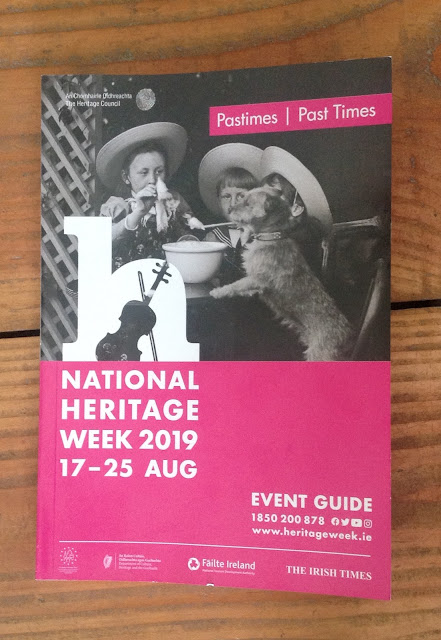
Heritage Week already! It feels like we've only just finished cleaning up craft supplies and tea lights after last year's events when it's time to get ready again.  This year National Heritage Week runs from 17-25 August with events literally in every county. The Irish Workhouse Centre has lots to offer with children's workshops, a Gaeilge Day and loads of free talks.  The theme this year is Pastimes & Past Times, exploring the links between history and hobbies. On Saturday 17th bring the kids to a craft session called 'Communicating in the Past'. The session is on at Portumna workhouse and run by local artist Paula Byrne  (cost 2 euro per child & booking essential).  Let the whole family explore the link between the ancient Irish alphabet called Ogham and Celtic tree-lore. For instance, did you know that we all have a tree linked to our name? Each child will craft their own special book mark to bring home. Start time is 12 o'clo...

The Hunger House by Conor McGuire

Image
The Famine was a seismic event in 19th century Ireland, and is probably the most universally known point in Irish history. With this in mind, it comes as no surprise that  historical fiction set in Ireland has been dominated by this event. However,  The Hunger House branches out in a new and widely neglected direction by exploring a different facet of life in 19th century Ireland; the workhouse. We are delighted at the Irish Workhouse Centre to be stocking this inspiring novel by Mayo writer, journalist and artist, Conor McGuire which is already an Amazon No. 1 Bestseller. The novel tells the story of intelligent Bridget Hennigan, who takes up the post of Matron at Ballina workhouse. Her quick mind and professional nature are a challenge to the all male administration which makes up the Board of Guardians. To make matters worse, the resident medical officer Dr Whyte is a nasty piece of work. Bridget realises that only she can stop him but at what price? Conor McGuire...

Workhouse Farms in Ireland

Image
Mangel Wurzel-a popular vegetable grown in Irish workhouses   For a long time, the 'work' in Irish workhouses was thought to exclude farming. However, recent research shows that many Irish workhouses had farms. Due to irregular or no account keeping, it is hard for us to piece together a picture of what farming was like in a workhouse setting. However, what we can do is look at a snap shot of figures from parliamentary documents.* These documents reveal a surprising fact. Out of the 163 workhouses across Ireland, only 37 had no land under cultivation. Over half of these 37 are from the second wave of building. Workhouse building in Ireland took place in two waves. There were the first 130 which were planned as a complete set to provide relief for 1% of the Irish population. Then the crisis resulting from potato blight led to 33 extra workhouses being hastily built. These were needed due to chronic overcrowding and it seems that acquiring farmland was the least ...

The Martello Towers of Ireland-a photographic exhibition

Image
Ireland's Eye, Howth by Tricia O'Neill The Irish Workhouse Centre is delighted to be hosting a photographic exhibition, The Martello Towers of Ireland, by Tricia O'Neill. The exhibition will launch on the 18th April with a talk by historian James Scully, an expert on Napoleonic fortifications. I managed to catch up with Tricia prior to the exhibition. After 20 minutes on the phone with photographer Tricia O'Neill, I realise that we should be talking about the history of Martello towers. Instead the stories come thick and fast. Did she tell me about the time an army officer had to back her car onto a small ferry because the ramp was too precarious? Or that it takes two seasoned historians to row out to Meelick Island? Or that in Boston an exhibition visitor doubted her photographs because of the beautiful light and he believed it rained in Ireland, constantly? Ireland's Eye, Howth from afar by Tricia O'Neill I soon realise that The Martello Towers ...

Wretched Old Shoes

Image
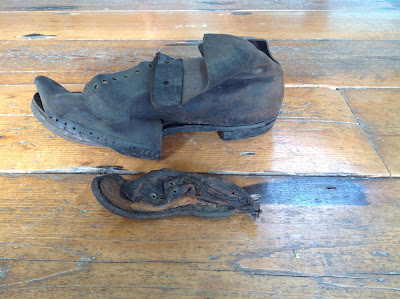
Two original items from Portumna workhouse, one is a child's shoe & the other a man's boo t. At the Irish Workhouse Museum we are delighted to have several specimens of pauper shoes. However shoes were viewed as a troublesome topic by workhouse management. Some workhouses ordered boot parts and had the paupers assemble them. Others bought them in ready made. Whomever supplied the shoes, it is clear that covering the feet of the poor was not a priority. In Co. Galway alone, six of the ten workhouses were in dispute with the Poor Law Commissioners in England over shoe and stocking provision. The result was newspaper descriptions like the one below: stockingless and  h is feet   were scarcely protected by wretched old shoes   (The Nation-Saturday July 30, 1864) The old pauper described in this article was alleged to be suffering from exposure due to his treatment at Portumna workhouse. A mere six months later, Rev. P. Donalan R.C.C. alleged two women nam...

It's Shorelines Time Again!

Image
Shorelines has taken over Portumna. The festival has once again filled the town with lots of thought-provoking, quirky, and just plain enjoyable arty-type stuff. The Irish Workhouse Centre has not been spared and we are delighted to be jam packed with delicious art in all shapes and forms. Once again we are all reminded what a great gallery space the workhouse is, and for those of you who wonder how cultural events fit in with the history of this site, here is some food for thought. The workhouse was originally meant to provide help and support to their immediate localities. They failed massively in this duty of care, but we can now readdress this balance using the same site. Heritage spots like ourselves, can and should be embedded in their local communities, providing something for everyone. Let's not keep making the mistakes of the past. Arts are the succour of the soul. The most heart-rending fact I learnt from tour guiding at the workhouse is that paupers, tho...

Irish Workhouses and Genealogy (Part 2)

-Parliamentary & Civil Records- Not all records relating to Irish Workhouses were generated in-house. In fact, much of what survives today are records created by the government.  A great government record is the 1901 and 1911 Census. This census lists all the inhabitants and staff of the various workhouses. Please note that the paupers are usually listed by initials. We can also use newspapers as a surprisingly full source of information about workhouse inmates and staff alike. If you are lucky you may even find information given about a pauper's family or the conditions leading to their admittance to the workhouse. The Freeman’s Journal, 27 August 1864 for example, refers to a man named Howard, commiserating with his fate and his diet, ‘…the horrid stuff miscalled “bread”, on which he was fed was unlike anything with which the paupers were fed before’. [1] In the case of Portumna Workhouse the most useful set of records are those of the civil death registers...

Irish Workhouses and Genealogy (Part 1)

In-house Records The workhouse system in Ireland is an often overlooked treasure trove of names, personal histories and local business names. It takes some time to find this information but it is well worth the effort. At the time of their operation, from 1840 up to the early 1920s, vast quantities of records were kept by each workhouse. These records were created by  The Board of Guardians (the group of men in each individual Poor Law Union which formed the administrative core of a workhouse), or the workhouse staff such as t he Master, Medical Officer, and Clerks.  The Board of Guardians This group of men were very interested with statistics and how their Poor Rate was being spent. To this end they discussed tenders for workhouse supplies and posts within the workhouse, salaries of staff and the suggestions of Poor Law Inspectors. From the minutes of the Board of Guardian meetings, we have a roll call of the board itself and there is evidence that the c...

Heritage Week Plans for 2018

Image
August is always an exciting month for the Irish Workhouse Centre as we celebrate National Heritage Week . Running from August 18th to 26th, Heritage Week will again be a major focus here. Steve Dolan (Our current Workhouse Master) with Claire Doyle (His beautiful assistant) The aim of National Heritage Week is to preserve our folklore, ancient legends and archive the stories of our past in our minds. It is an event tailored to people of all ages and represents every facet of the Irish identity. This year, the theme of Heritage Week is ‘connections’. We encourage people to get involved and ‘make a connection’ to their heritage. Our heritage belongs to us, and it is important that we preserve and cherish it. We will host ten events over the nine days, will hold ten events off-site, and are providing nine free publications over the nine days.   No centre or museum in the county holds as many events as the Workhouse. Perhaps, some of these events might interest you......