Posts

June Events: Landed Estates Conference and Paul Strzelecki Exhibition

Image
June has two very exciting events happening at the Irish Workhouse Centre. The first is our Annual Landed Estates Conference and the second is the opening of a permanent exhibition devoted to Paul Strzelecki (A Forgotten Polish Hero of the Great Irish Famine). Landed Estates Conference At the beginning of the 19th century there were over 4,000 ‘Big House Country Estates’ in Ireland. Today there are less than 100.  These estates, and attached mansions, symbolized the economic strength and social standing of different landed families. However, estates were about far more than just the ‘Big House’, they were also an intrinsic part of  tenant and labourer lives, and are a vital part of understanding Ireland's  economic history.  In essence, the story of the big house is the story of Ireland in the 18th and 19th centuries. Our special guest speakers this year are Dr Karol Mullaney-Dignam and Dr Marion McGarry. Itinerary: 10:00     John Joe C...
Transition Year Art Collaboration

Image
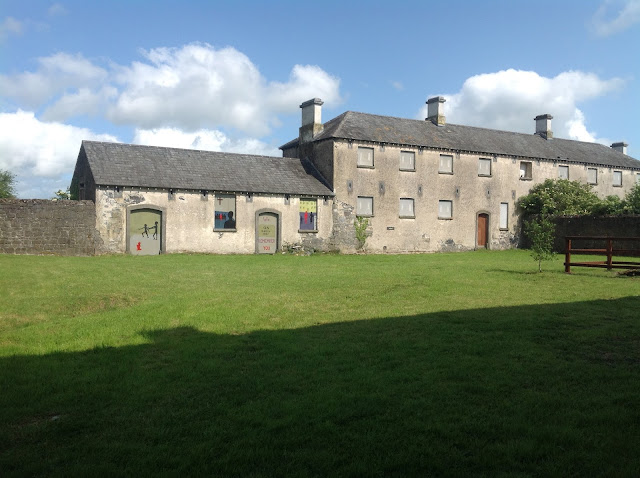
A group  of Transition Year students, namely  Jessica Madden, Keeva Duffy, Maria Quinn, Cerys Porter, Shauna Fahy and Sean Power, have reached out to Portumna workhouse. As a group they  designed and painted a series of boards for the workhouse infirmary. Here are their own words about the project. "We got inspiration mainly from what life would be like if you lived in a workhouse.  The boards consist of four scenes which are now in the places where the original infirmary doors and windows were missing.  A family entering the workhouse The paintings tell the story of a person's life in the workhouse, from our own perspective. We decided to have a main focus throughout the works; a man in red. He became our main character in the story.  The first board shows him entering the workhouse with his family. We tried to depict the fact  that the family had no other option if they wanted a chance of survival.  Seperation scen...

The Irish Workhouse Museum is Open!

Image
Our inaugural plaque, designed and hand-painted by Paula Byrne The Irish Workhouse Museum is officially open! The opening on Saturday 18th was launched by Minister of State Sean Canney TD and marks a new, exciting era for the Irish Workhouse Centre (IWC). The museum is located in a former womens' workroom and houses the centre's collection of artefacts. These range from the shaft of a workhouse cart to the tiny, blacksmith made nails which were used in workhouse construction. The impact of the museum is succinctly described by long-term supporter of the project, Dr. Christy Cunniffe, Community Archaeologist for Galway.   'Artefacts and personal objects can tell big stories. The workhouse tour brings the building to life, and the museum will do the same for their objects. Just look at the pauper shoes we have discovered at Portumna. Nothing expresses the sadness of workhouse children like those reminders of tiny feet.' A case of enamelware and bo...

Workhouse Farms in Ireland

Image
Mangel Wurzel-a popular vegetable grown in Irish workhouses   For a long time, the 'work' in Irish workhouses was thought to exclude farming. However, recent research shows that many Irish workhouses had farms. Due to irregular or no account keeping, it is hard for us to piece together a picture of what farming was like in a workhouse setting. However, what we can do is look at a snap shot of figures from parliamentary documents.* These documents reveal a surprising fact. Out of the 163 workhouses across Ireland, only 37 had no land under cultivation. Over half of these 37 are from the second wave of building. Workhouse building in Ireland took place in two waves. There were the first 130 which were planned as a complete set to provide relief for 1% of the Irish population. Then the crisis resulting from potato blight led to 33 extra workhouses being hastily built. These were needed due to chronic overcrowding and it seems that acquiring farmland was the least ...

The Workhouse in Fiction

Image
Image from the 1968 movie Oliver! ‘Please sir, can I have some more?’ Most of us know this iconic line from the 1968 film version of Oliver! The quote has embedded itself in pop culture, cropping up in memes, advertisements, comedy sketches and cartoons. However, how many of us know that the line is a criticism of the meagre food quantities supplied to workhouse children? In fact, Charles Dickens wrote Oliver Twist as a rallying cry against child poverty and the failure of the workhouse system. He based this view on his first hand observations as a newspaper reporter. What he saw went into his books and shocked  his audiences. He was accused of gross exaggeration and even outright fabrication. His rebuttal was the tell people to go see for themselves, which they did. What they witnessed was all the proof he needed. Before we leave Dickens, it is interesting to note a slight connection with Irish workhouses. Oliver Twist was first published as a serial 1837–39. This peri...

The Martello Towers of Ireland-a photographic exhibition

Image
Ireland's Eye, Howth by Tricia O'Neill The Irish Workhouse Centre is delighted to be hosting a photographic exhibition, The Martello Towers of Ireland, by Tricia O'Neill. The exhibition will launch on the 18th April with a talk by historian James Scully, an expert on Napoleonic fortifications. I managed to catch up with Tricia prior to the exhibition. After 20 minutes on the phone with photographer Tricia O'Neill, I realise that we should be talking about the history of Martello towers. Instead the stories come thick and fast. Did she tell me about the time an army officer had to back her car onto a small ferry because the ramp was too precarious? Or that it takes two seasoned historians to row out to Meelick Island? Or that in Boston an exhibition visitor doubted her photographs because of the beautiful light and he believed it rained in Ireland, constantly? Ireland's Eye, Howth from afar by Tricia O'Neill I soon realise that The Martello Towers ...

Wretched Old Shoes

Image
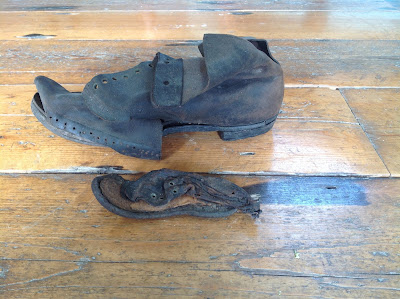
Two original items from Portumna workhouse, one is a child's shoe & the other a man's boo t. At the Irish Workhouse Museum we are delighted to have several specimens of pauper shoes. However shoes were viewed as a troublesome topic by workhouse management. Some workhouses ordered boot parts and had the paupers assemble them. Others bought them in ready made. Whomever supplied the shoes, it is clear that covering the feet of the poor was not a priority. In Co. Galway alone, six of the ten workhouses were in dispute with the Poor Law Commissioners in England over shoe and stocking provision. The result was newspaper descriptions like the one below: stockingless and  h is feet   were scarcely protected by wretched old shoes   (The Nation-Saturday July 30, 1864) The old pauper described in this article was alleged to be suffering from exposure due to his treatment at Portumna workhouse. A mere six months later, Rev. P. Donalan R.C.C. alleged two women nam...